In a previous post I explained why multitasking is impairing your productivity and efficiency and suggested turning off notifications on your devices.
I know this may be easier said than done. We don’t want to miss important calls from a prospective customer or an urgent question from a team member. So, how to go about it?
Here are 3 steps that’ll help you work around this problem:
Ask yourself the question: What is the time of day with the least calls or disruptions? This could mean dealing with kids at home, answering calls from your team or customers, you name it.
This time with the least disruptions is your focus time, time to work on your complex and important projects or tasks. Turn off notifications on all your devices or set them on flight mode, turn off everything that would distract you, and yes, that means TV and radio, and get to work.
Everything that will land in your inbox or on your voicemail will be attended to after your focus time.
Last but not least, don’t allow anybody to “steal” this time from you (emergencies excluded of course). Inform your team, your colleagues, or your family that you’ll be offline for x-amount of time and available afterwards.
I know, it’s far more difficult with kids. But even with kids there are periods in your day during which they won’t need you. Maybe you have to be more flexible. Maybe you have to limit your focus time to 20 minutes instead of one hour. Whatever time you can carve out make sure you use it well.
Remember, there is no such thing as perfect, but there is always the best we can do.
Sometimes the best way to make progress is stepping away from whatever we are doing. It may sound counterproductive, so let’s have a look at why this may be true.
Imagine you are working on a project and have made quite some progress, but all of a sudden you get stuck. You run into a problem and, for the life of you, you can’t figure out how to solve it.
Instead of wracking your brain hour after hour, going for a walk, talking with a colleague, getting your daily exercise in, may be far more conducive to finding the solution because you allow your brain to shift and get a fresh perspective.
How often have you struggled with a task and just because you were called away from it you later realized that the solution was staring you in the face, you just didn’t see it? Or you notice something that has escaped you before?
Don’t wait for someone to call you away. Take the initiative!
Take a break. Do something unrelated. Give yourself some time to look at the problem with a fresh set of eyes. I bet you’ll come up with an answer.
“Most of the time multitasking is an illusion. You think you are multitasking, but in reality, you’re actually wasting time switching from one task to another.”
Every time I hear the word “multitasking” I cringe. Why? Because 99% of humans can’t do it. It’s a myth. What we may perceive as or call “multitasking” is in fact the splitting of our attention between tasks. Our brain very quickly moves back and forth between tasks and that is costing energy and brain power.
The worst part? We tend to make mistakes or overlook important details and have to redo our work or correct our mistakes.
What does this mean in terms of our productivity and efficiency? Instead of being faster and more efficient, we actually need more time. This is particularly significant when we’re working on complex problems or tasks. Once taken out of our train of thought by a notification, a phone call, a quick chat, you name it, we need to find our way back to where we have left off.
Do you have time to squander? If the answer is no, I invite you to turn off your notifications on your devices, turn off your TV, and turn off your radio when you need to concentrate on a complex task. Your work will be better for it, and you will be done quicker. If you want to read a little more about multitasking, go to my blog: The Myth of Multitasking
Have you had this experience? You started your day deciding you will finish one specific task, and at the end of the day you didn’t even come close to looking at it, let alone working on it? That’s why it is a good policy to start with the most important task at the beginning of your day.
You are fresh, your brain is in its most active phase, and you get a great sense of accomplishment and boost for the rest of your day.
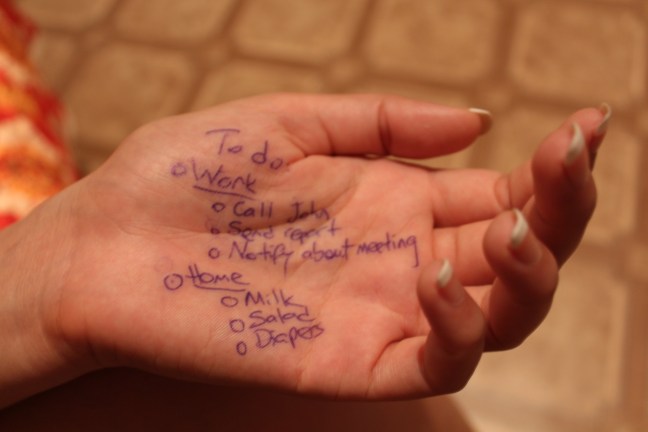
Why would anyone want to explain the difference between a to do and a project? The simple fact of the matter is, there is quite often a misconception about the two.
I’m sure you would agree that the redesign of a website is a project, a big one. But purchasing a gift for a friend… most likely not.
Let’s have a closer look at the two terms and see what qualifies as a project and what qualifies as a to do. Is the following a project or a to do? Buying a present for your best friend? The answer: it depends, and here is why.
It’s a to do if: You know exactly what to buy, where to buy it and that it’s in your budget.
It’s a project if: 1. You don’t have a clue what you want to buy and need to do some research. 2. You have to figure out where you will get what you’re looking for. 3. You don’t know if it’s in your budget.
David Allen, who created the methodology “Getting Things Done,” came up with a clear and simple distinction:
To Do: If only one action step is required to reach the desired outcome.
Project: If the desired outcome requires several action steps.
Why is this important? Because it helps you think differently about your planning and time commitment. There is a big difference between ordering something online vs. having to do some research and then moving on to the purchase. Sounds kind of obvious, doesn’t it? But that’s not necessarily the way we think about it. By not being specific about the various steps (of this little project) we tend to greatly underestimate the time it will take to get it done. Our mind deceives us. Buying a gift for our friend equals to: “not a big deal” and “done quickly.” If, however, we consider the various steps, our mind changes from “done quickly” to “it’ll take a bit of time.”
If you look at the bigger picture it can turn into a vicious cycle. Because you underestimate the time you’ll need to accomplish something you constantly feel “behind” or playing catch-up which in turn results in stress. Something we all have enough of.
If this sounds like you and you feel you’re always behind and chasing time, there are three simple steps you can take to improve your time management.
Step 1 – Make a List
Make a list of all the things you want or need to do, either on paper or electronically.
Step 2 – Note All Necessary Steps
Determine what requires only one action step to be completed and what requires two or more action steps. Note all the necessary action steps required to finish each “project.” Remember, everything that takes more than one action step is not a to do but a project.
I’ll use my example “go grocery shopping,” something everyone can relate to. Here my process before I get into the car:
Plan what I will make for dinner.
I may have to check a recipe for ingredients and add any missing ones to my shopping list.
I’ll also check what I have to restock in the fridge and/or pantry. I add these items to my shopping list as well.
Step 3 – Block Time in Your Calendar
Blocking time in the calendar. What is the best time to work on my project? Again, let’s use the project “go grocery shopping” as an example. I like to go shopping when stores are not crowded, i.e. not on weekends and not around the time school ends. Having said that, in case I’m on the road and pass a store, especially one that is a little farther away, I’ll do the shopping en route.
After all, the whole point of this exercise is to make the best use of your time and eliminate as much stress as possible.
If you have recurring action steps, keep an eye on the time for future planning. The more you learn about the time commitment for various tasks, the better for your planning. Being more conscious about your time will help you make better decisions of what to do and when to do it.
Last but not least, let’s have a quick look at some electronic task management and project management systems. You’ll find quite a few. Whichever tool you choose, keep it simple. Use tool(s) that appeal to you, that are intuitive, and fit your work style. The process is the same, but instead of writing things on paper you collect your to dos and projects with sub-tasks in a task management tool.
My repository for projects and tasks is the Microsoft To Do task manager. I find it’s intuitive and easy-to-use, and it synchronizes over all my devices (laptop, cell phone, office computer, tablet). No matter where I am, I always have my phone with me and can easily add something. This way I don’t have to worry about anything falling through the cracks. Other task managers I have used in the past were:
Now over to you. What are you doing to keep track of your to dos and projects? Do you prefer a paper list or are you more an electronic kind of person? What tools are you using? Do you have any tips? Or are you struggling to keep track of everything? Let’s talk or let me know in the comments below.
I came across the video “3 simple tips of making better decisions” (3:31 min) by the BBC, and it tickled my interest. Human beings constantly have to make decisions. In a research done at Cornell University in 2018 it was estimated that on average an adult will make approximately 35,000 remotely conscious decisions each day. That’s a lot.
Of course, not all of these decisions have the same weight or impact on our lives, in fact, we make most of them unconsciously. And that’s good, because if we would think about each one, we would suffer analysis paralysis and would be totally overwhelmed.
So far so good. But if we consider that, according to Dr. Modgil, all decisions, big or small, require the same amount of brain energy, then it doesn’t really matter if we make a big or small decision. It is far more important when we make a decision. How could we ensure that we have enough energy for the ones that are really important? How do presidents, CEOs, or doctors, who constantly have to make decisions, have or preserve energy to make (mostly) good ones? And more importantly, what could we as entrepreneurs learn from them to improve and get better at decision making? After all, our livelihood may depend on it.
The answer is surprisingly simple. Some of the most successful or creative people just don’t bother with small decisions. They create habits instead, eliminating as many small decisions from their days as possible. I‘m referring to decisions such as what to have for breakfast, what to wear, how to start the day, or what to do first after arriving at the office. By creating these habits they eliminate energy sucking decisions, energy that would be far better used for more important questions or problems.
I’m not sure if this was his intent, but take Steve Jobs for example. He would only wear black turtlenecks and jeans, every single day. When he stood in front of his closet there wasn’t anything he had to think about. He just grabbed any turtleneck and any pair of jeans, done. This is a little bit too extreme for my taste. But there are other options to remove this decision from your morning. One option would be putting your clothes out the night before. Or maybe deciding what to wear for a whole week. If you’re traveling you do it as well.
Or consider a “morning routine.” As the word suggests, it refers to activities in the morning that you repeat every day preserving brain energy for other decisions later in the day. Depending on your personal schedule and lifestyle you design your morning routine based on what is important to you and what you would like to gain from it. The book “The Miracle Morning” by Hal Elrod and Cameron Herold provides a lot of examples of routines successful people created for themselves to guide their days in order to meet their professional and personal goals.
Creating habits is only one of the three aspects mentioned in this video, but surely worth giving it some extra thought considering it may have a positive impact on our businesses and our lives.
As a side-bonus, it also gives some structure to your day and, based on my own experience, a morning routine guarantees a good start into the day. But you don’t have to stop here. Take a moment and look at your day and your work. What else could you either simplify, delegate or altogether eliminate? What is eating precious brain energy that would be much better used for more pressing or more important questions or challenges? Give it some thought.
Also, consider the time of day when you make big decisions. For me the saying “You should sleep on it” just got a completely new meaning. Give your brain the time to work on your question overnight and recharge. I’m sure it won’t be the first time that you find a brilliant solution while standing in the shower.
Do you struggle with too many tasks and projects and don’t know how on earth you’ll ever get everything done? My advice: Stop multitasking!
Except for routine tasks, we humans are not capable of it, at least the overwhelming majority of us. In fact, multitasking is a misnomer. The word suggests that we do two tasks at the same time, when in fact our brain switches back and forth between two tasks. We just don’t notice it because it happens so darn fast.
You could argue that it doesn’t matter as long as you get your work done. But that is exactly where multitasking or the perception of multitasking turns into a problem. Our brain only has a limited capacity for processing data. The more complex a task, the more data needs to get processed, the more difficult it is for the brain to switch, the more time it takes.
If you imagine your brain as a multi-laned highway, all lanes are occupied with data that is needed to tackle the one task at hand, let’s say writing an email. If you add a second task, for example answering the phone, you split the data highway into two. Some lanes are occupied with data to write the email, but some lanes are now used to speak on the phone. Your attention is divided, your brain switches back and forth between the two tasks, and that has consequences.
The obvious result is that you may lose track of what the caller is saying because your brain was more engaged with the email. You may find that you made mistakes in your email because …. you get the idea.
Multitasking for most of us is only an illusion that impacts our performance, quality of work, and quite often also the quality of our lives. Instead of getting done more our brain is forced to switch back and forth between the two tasks, which essentially slows us down. An article of the American Psychological Association describes several experiments on task-switching. The goal was to determine the cost in time for switching tasks, and to assess how complexity or familiarity of tasks would impact the time of switching and productivity.
“Although switch costs may be relatively small, sometimes just a few tenths of a second per switch, they can add up to large amounts when people switch repeatedly back and forth between tasks.”
What is even more important is the fact that […] “multitasking may seem efficient on the surface but may actually take more time in the end and involve more error” and it can cause mental blocks that […] “cost as much as 40 percent of someone’s productive time.”
In short, the mind and brain are not designed for heavy-duty multitasking because it negatively impacts our mental processing ability.
Remember those moments when you were immersed in your work, the phone rang, you picked up and… the great idea that you just had disappeared? You may not even have started talking, but by switching from one task to another, you lost it. And starting where you left off usually takes some time. You need to connect the dots again in order to continue.
What could this mean for you and your work? If you have something simple to do like putting dishes into the dishwasher, loading your washing machine, and at the same time talking with a friend on the phone – keep on doing it. I don’t think it will either impact your conversation nor the outcome of the laundry or dishes. But if you are working on something complex like writing a blog, doing some research, or writing a proposal, you may want to reconsider. Focusing on one task and finishing it not only gets stuff off your To-Do-list, but it also gives you a feeling of accomplishment.
Especially if you feel overwhelmed with the amount of work you have to do, take some time to plan. Write down what you have to do and then decide when you will do it. I know, it may sound more like additional work instead of helping you to get stuff off of your To-Do-list. But the benefit of this exercise is that you can use quiet and undisturbed time for the really heavy-lifting and do the easy stuff when you have to expect or deal with distractions.
Give it a try. For the next couple of days focus on one task at a time. Pick a time that will allow you to concentrate 100 percent on it. How does it make you feel? Did you get the task done quicker? Did you enjoy this uninterrupted focus time? How did it feel getting it completely done? Something like this?
We made it to part 3 (here are part 1 and part 2), the part that is in fact a constant work in progress: developing and cultivating good (work) habits. Especially during very busy times or at times when motivation is a little low in supply, they can be a lifesaver.
According to the Oxford Dictionary a habit is “a settled or regular tendency or practice, especially one that is hard to give up.”
Since we’re focusing on good work habits, that’s exactly what we’d like to achieve. We aim for minimal effort to get something going or help us getting over a hump. Yes, I do realize that habits also have a dark side, but for the purpose of this blog let’s focus on the positive ones.
How do you go about cultivating good work habits? As the word “cultivating” implies, it takes time, effort and experimentation. You start off with a strategy or idea and over time you learn if it’s working for you or not. You may get tips from others, observe others how they do something or deal with a situation, or you read about it. In some cases, you’ll know right away what won’t work for you. Perfect. This saves you time, so don’t even bother. In other cases, you have to try to find out if this suggestion suits you, and tweak it a bit to make it yours.
What it actually comes down to is that you really have to get to know yourself, the flow of your day, situations that may throw you off, and all the other little sneaky things that keep you from doing what you should or need to do.
Cultivating good work habits isn’t a skill, it’s a practice.
Planning Your Day
Calendars – Planners
One of my most crucial habits is planning my day. My preferred way is to plan the next day the night before. Sometimes that doesn’t work, so I do it before I start my day in the office. I noticed, however, that when I do it the night before I get up in the morning and already have a plan. It just feels good to visualize the day ahead, know where I have to be when, and what I would like to have done by the end of it.
Insights & Actions
In one of my previous blogs I mentioned that at the end of most days I take a moment to check in and see what worked and what didn’t. I call it “Insights & Actions.” By doing so I discovered what my most productive environment looks like, when I’m getting things done, but also when I struggled to finish or do my work. I include these insights in my planning.
The Most Difficult Task
If I have something that I find difficult to do, I try to get it out of the way as early as possible in the day. Good-bye procrastination. By getting it done right away I feel good about having tackled a difficult task, but, maybe even more importantly, I also avoided allowing it to become a “bigger” problem, at least in my head. A win-win!
Calendar Miracle
I have also started using my calendar in a better way. Why do I mention this? Stay with me, I’ll explain. To keep track of my tasks I use Microsoft To Do. Each morning I go through “My Day” and check the things I plan on doing. That includes quick things like calling someone or checking on the status of something, but it also includes all my projects such as redesigning my website, doing research for and writing my next blog. What it doesn’t show is the amount of timeI may need for the individual tasks. That was a BIG problem for me. The number of tasks I wanted to tackle per day was simply unrealistic. After I started blocking chunks of time in my calendar for the bigger projects, I got much better at estimating what I can accomplish each day. A tiny change with a huge impact.
Dressed for the Occasion
Dressed for the occasion
Be Ready
In order to be able to focus on your work, it is helpful to have everything ready before you start. Like a chef who prepares his workstation and has all ingredients handy before he starts cooking, putting everything in place for the work you intend to do avoids distractions. I’m talking about files, documents, notepaper, pen, something to drink, you name it. It’ll cost you precious time, for example, if you have to search for a specific document in the middle of your work. The same idea can be applied when you are finished with something. I still remember that I was turning my office upside down in search of a document I hadn’t filed away after a conference call. I had buried it under a pile of paper totally unrelated and it took me quite some time to dig it up again.
The Myth of Multitasking
Multitasking is an interesting concept, at least when used in connection with humans. Women are supposedly much better at it than men. Unfortunately, this is a myth. Multitasking is a concept from the computer world and should stay there. We, as humans, usually do a lousy job if we try. We either sacrifice our attention or the quality of our work if we attempt it. What does this have to do with good work habits? It’s simple. If you work on a complex task or need to focus on something a good work habit is to eliminate distractions.
Lack of Motivation
What can you do if you lack motivation? Do you need a break? Would calling a friend help you? You most likely know other solopreneurs or “home workers.” Go ahead, call someone and ask for a little pep-talk. If you can afford the time, do something else on your To Do list. I’m sure there is something on it that’ll kick you into gear again. Move your body, exercise, take a walk around the block, do your laundry, turn on music, do some jumping jacks.
A friend of mine rewards herself with a good book, a coffee, a movie, something fun after she has finished a specific task.
And sometimes you have no other choice but bite the bullet and do it, whether you feel like it or not. Sounds familiar? Then you may know Steven Pressfield’s book “The War of Art.” If you don’t know it, it is “A vital gem… a kick in the ass,” according to Esquire.
Batching
Before I come to the end, there is one more habit I’d like to mention: batching. Batch similar tasks. It’s much easier for the brain and needs less energy. As an example, don’t pay invoices or enter a payment each time you receive one. Wait until you have a couple, and do them all at once. If you have to make a bunch of calls, schedule a time to do them all. If you need to find images for your blog and/or newsletter… you get the idea.
Now let’s wrap this up for today. I mentioned a couple of habits you may consider trying out. If you do, be consistent. Give it some time (I’m not talking about days, I’m talking about weeks!). Ask yourself along the way, what works and why and what doesn’t and why. These answers will hold the information you’ll need to find and cultivate your own best habits.
A good time to look at your habits and routines is when you or your business undergo change. The questions to ask are: Do these routines or habits still serve and support me? Is there a better or easier way to do it?
And with this, I am turning this over to you. Do you have proven habits or routines you swear by? Please let us know.







 Regine Albrecht-Strategies with A Kick